The Name Could Not Fit in the Boxes.
What Twenty Letters Reveal About Standardization, Identity, and the Meaning Systems Cut Away
Angeli Gianchandani on the first system that tried to make her fit, and why the best brands never do.
The Edge | By Angeli Gianchandani · October 12, 2026 · 3 min
Twenty Letters
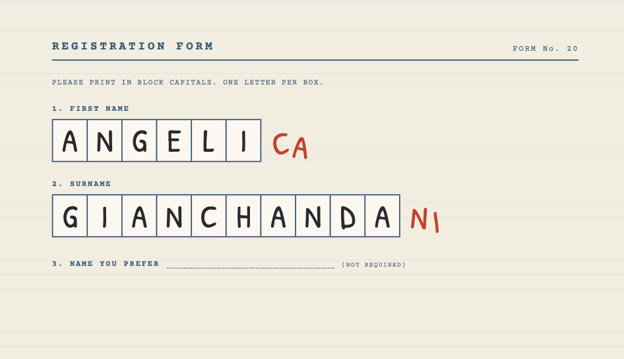
Angelica Gianchandani. Twenty letters. Every form I ever filled out had boxes, one letter per box, and the boxes always ran out before the name did. So the name adapted: Angelica became Angeli. Not because anyone asked what I preferred, but because the form had already decided how much of me it had room for.
This is not a story about inconvenience. It is the story of the first system that taught me what standardization leaves behind, because the boxes made room for efficiency before they made room for meaning, and organizations build their boxes exactly the same way.
The people holding the forms struggled too. At roll call the teacher would pause, eyes dropping to the attendance sheet, then up at me, then back again, and the whole room waited while my name negotiated with the person reading it. Fifth grade, sixth, seventh, freshman year of college, first job, conference stages. Sometimes they would ask if they had said it correctly. Close enough, I would reply, because accuracy mattered less than moving the room forward. Eventually I started helping. Do you want to buy a vowel, I would ask, or pick a consonant? Wheel of Fortune rules. It usually gets a laugh, and more importantly, it gets us through the introduction.
Nobody ever asked what the name would have said if they had let it finish.
The Logic of the Box
The box is not evil; the box is efficient. Standardization is why planes land safely, why prescriptions do not vary by a pharmacist's mood, and why a production line in one country matches a production line in another. For processes, the box is civilization.
The failure begins when organizations take a tool built for processes and apply it to identity. The box cannot tell the difference between a checklist and a person, because it was never designed to understand people; it was designed to process them. Every organization is full of these category errors: job titles that flatten what people actually do, templates that make every market sound the same, onboarding that processes people like forms, brand guidelines so rigid they mistake consistency for understanding.
That is not discipline. It is truncation, and truncation almost always cuts away the part that carried the meaning.
One Size Fits None
Here is where most companies get the lesson exactly wrong. They constrain themselves to being consistent and build a box: same message, same voice, same campaign, everywhere.
But not every box truncates. I spent time inside Tiffany & Co., where the box is the brand, a color with no logo on it, recognized in New York, Tokyo, and Dubai before it is ever opened. The box is identical everywhere; what it means arrives through each culture's own idea of the occasion, the proposal, the anniversary, the dowry, the promise. Most boxes are built to make things fit. That one was built to carry meaning.
Organizations do not endure because they standardize. They endure because their identity survives translation.
What the Machine Inherits
AI is the biggest box ever built. It standardizes at a scale no bureaucracy ever could, and it will happily truncate whatever does not fit its fields, politely, without ever knowing what it cut.
The organizations feeding themselves into that machine should ask the question the boxes never asked me: what part of this did not fit, and what did it carry? The pattern only survives the machine if someone decided it was worth keeping before the machine arrived.
The Part I Kept
The boxes shortened my name. They did not shorten me.
Angeli is what fit. It is the name on this newsletter, and it will be the name on my book. The letters that don't fit did not disappear; they simply waited for a place where they could exist.
No form could ever tell my whole story, but that was never the box's job. It was always mine. The forms were never measuring me. They were measuring the limits of the system that built them.
About The Edge
The Edge examines how culture, business, leadership, sport, and global systems shape markets, institutions, and leaders' decisions. It features original essays and analysis by Angeli Gianchandani.
Copy Editor
Enid Burns is a Detroit-based journalist and editor. Her work has appeared in CNN, the New York Post, and CNET. She serves as copy editor for The Edge, reviewing each article before publication.

About the Author
Angeli Gianchandani is a global brand strategist, cultural intelligence practitioner, and educator. She is the creator of the CULTURE Framework™, and advises leaders on commercial growth, brand value, and the decisions connecting current performance to long-term opportunity. She is Adjunct Faculty at NYU School of Professional Studies, Visiting Lecturer at African Leadership University, and holds a master's degree from Tufts University’s Fletcher School. Read more at mobilitygirl.com/theedge and Authory.