Hong Kong's last mahjong carvers are not disappearing because nobody wants to learn the craft. They are disappearing because the tools to teach it vanished first.
Angeli Gianchandani traces what a dying craft in Hong Kong reveals about how institutions actually pass on what they know, and what happens when the infrastructure disappears before the people do.
The Edge | By Angeli Gianchandani · July 21, 2026 · 6 min read
The skill was fully recorded. It still had nowhere to land.
Karen Aruba, the Hong Kong illustrator behind Karen Aruba Art, is the daughter of a master carver and the granddaughter of a family that ran one of the city's mahjong tile factories for fifty years. When she set out to teach the next generation, she had illustrations, patterns, video, and her father's work to reference. What she did not have was tools. The factories that once made them had left Hong Kong with the tile factories, and you cannot replace them with any tools you find at a hardware store.
You can write down everything a master knows and still lose the skill entirely, because some knowledge does not live in words. It lives in the hand, built through repetition, adjustment, failure, and correction. Take away the means of practice, and there is nothing left to pass the record to.
Not the story you think
This is not a story about a dying craft. That story has been written many times: interest is thin, machine tiles are cheaper, and rent is too high for a shop that sells sets of 144 tiles, and sometimes just one set a week. All of that is real, and none of it is the interesting part.
The Actual Bottleneck
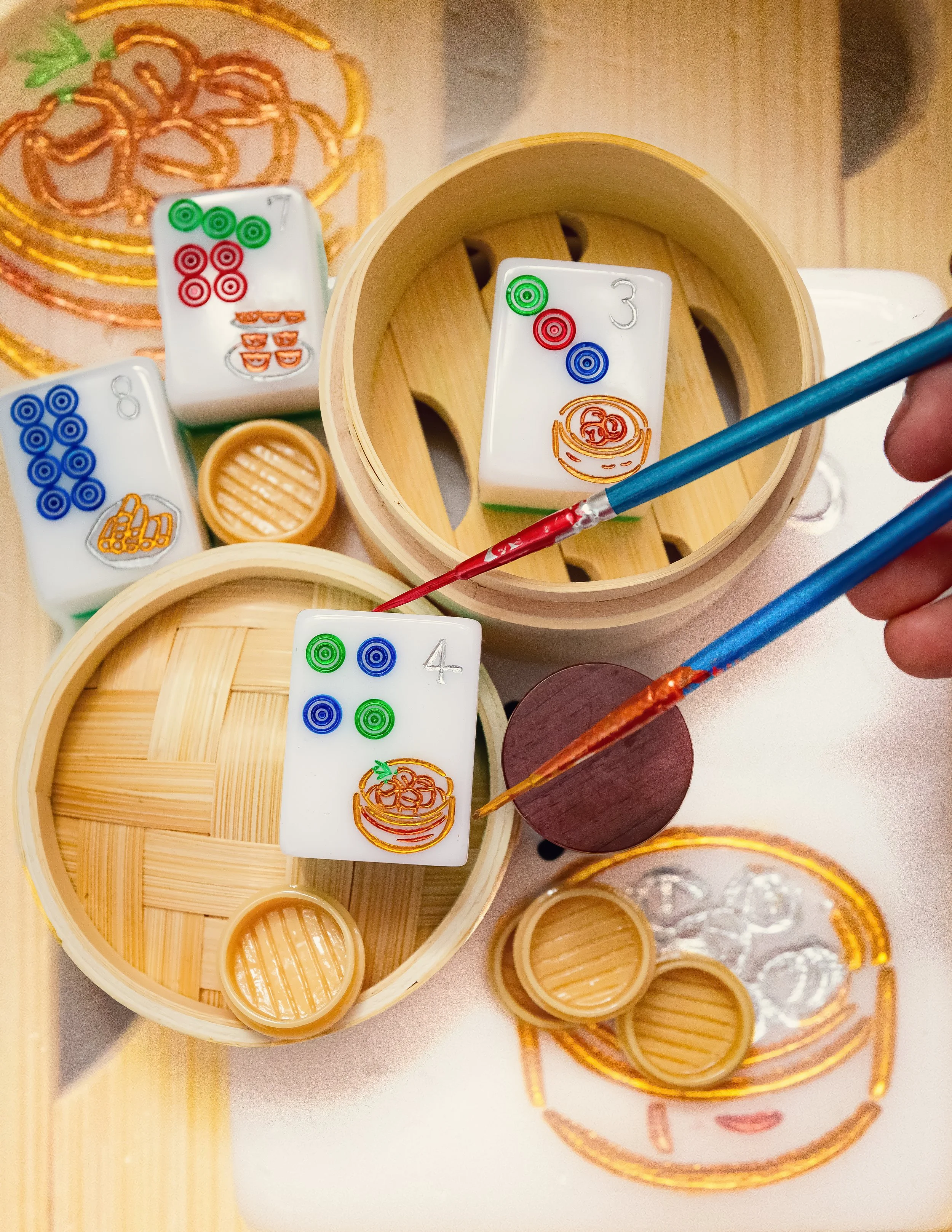
Photo: Karen Aruba Art / Fannie Wong
Aruba is one of the artisans featured in a recent Wall Street Journal film on Hong Kong's last hand-carvers. Her father learned the craft as a boy and practiced it for decades, until demand declined, costs climbed, and the mahjong tile factories relocated to the mainland one by one, until none remained in the city. The specialized carving tools went with them, and while a master could keep his own set, nobody in Hong Kong could make a new one.
"I realized that if we want to teach people handcrafting," Aruba says, "they do not have enough tools." Her husband's brother, a wood craftsman, recreated the first few sets, and a factory in Malaysia replicated the scissors, the small instruments shaped for each cut. Now there are five to eight full sets, enough for students to practice.
Mixed media, hand-carved and laser-engraved. This balance protects Master Cheung's hands and eyes while keeping the craft, and the culture behind it, alive.
The Uncomfortable Part
Mahjong is having a global moment right now, which is what makes Aruba’s story instructive rather than simply sad. In Lagos, my own cousins turned me away from their mahjong afternoon: a serious, competitive game, no room for a player who slows the table down. At my mother's 55-plus community, the opposite table: all players welcome. London, Madrid, Dubai: custom tile sets and tablescapes, built around a game their cities have no historical link to, with demand stronger than it has ever been.
And the craft nearly died anyway, because a surge in people who want to play did almost nothing to protect the people who still know how to carve. You can meet booming demand entirely through machine-made tiles, no hand-carving required anywhere in the supply chain. Fashion has a name for this: the designer's own hand versus the label that survives them, priced apart as provenance. The boom buys the label, and interest does not automatically route back to the person holding the endangered skill; someone has to build the pipe.
Aruba built it anyway, before there was any demand for the teaching. Hong Kong's carving trade once had its own version of an atelier, the factories where craft passed from parent to child at the workbench. When the factories left, the masters who stayed became sole practitioners with no successors. Aruba is rebuilding the atelier while the founder is still alive.
Beyond Mahjong
Aruba's tools were physical. Most institutions lose something less visible but just as concrete: a way for one person's judgment to become another person's practice. Perfect documentation would not have been the tool. The raw material never disappears, but structured access to it does.
Medicine solved this long ago. A residency puts real patients in front of trainees, under supervision, thousands of times. In most organizations, the equivalent tool is whatever forces someone to practice the actual judgment: shadowing a decision, taking the hard case before the expert leaves rather than after.
When that person leaves, the documentation is usually fine. The structure for practicing their judgment rarely exists, because nobody built it until the hands that held it were gone. An institution is a system for repetition. The tools do not just make a skill possible. They make it transferable.
Copy Editor
Enid Burns is a Detroit-based journalist and editor. Her work has appeared in CNN, the New York Post, and CNET. She serves as copy editor for The Edge, reviewing each article before publication.
Sourcing
Reporting drawn from the Wall Street Journal's film "Why a $1,000 Mahjong Set Can Take 10 Days to Make" (https://on.wsj.com/4oZOQLP), Karen Aruba's own account of the industry's relocation (https://www.karenaruba.com/blog/2022/12/28/interesting-hidden-story-about-mahjong-tile-industry-in-hong-kong/), and coverage of Hong Kong's remaining carvers in the South China Morning Post (https://www.scmp.com/news/people-culture/article/3206390/she-designs-he-carves-hong-kong-father-and-daughter-generational-fight-save-dying-art-mahjong-tile) and RADII (https://radii.co/article/the-last-female-mahjong-carver-in-hong-kong). Image used with permission of Karen Aruba Art, photographed by Fannie Wong.
About The Edge
The Edge examines how culture, business, leadership, sport, and global systems shape markets, institutions, and the decisions leaders make. It features original essays and analysis by Angeli Gianchandani.

About the Author
Angeli Gianchandani is a global brand strategist, cultural intelligence practitioner, and educator. She is the creator of the CULTURE Framework™, and advises leaders on commercial growth, brand value, and the decisions connecting current performance to long-term opportunity. She is Adjunct Faculty at NYU School of Professional Studies, Visiting Lecturer at African Leadership University, and holds a master's degree from The Fletcher School at Tufts University. Read more at mobilitygirl.com/theedge and Authory.