Who Holds the Pen, and the Club
Michelle Wie West Understood the Game Well Enough to Redraw It
Angeli Gianchandani argues that access puts a player in the club, while authority puts the pen in her hand.
The Edge | Angeli Gianchandani · September 28, 2026 · 4 min read
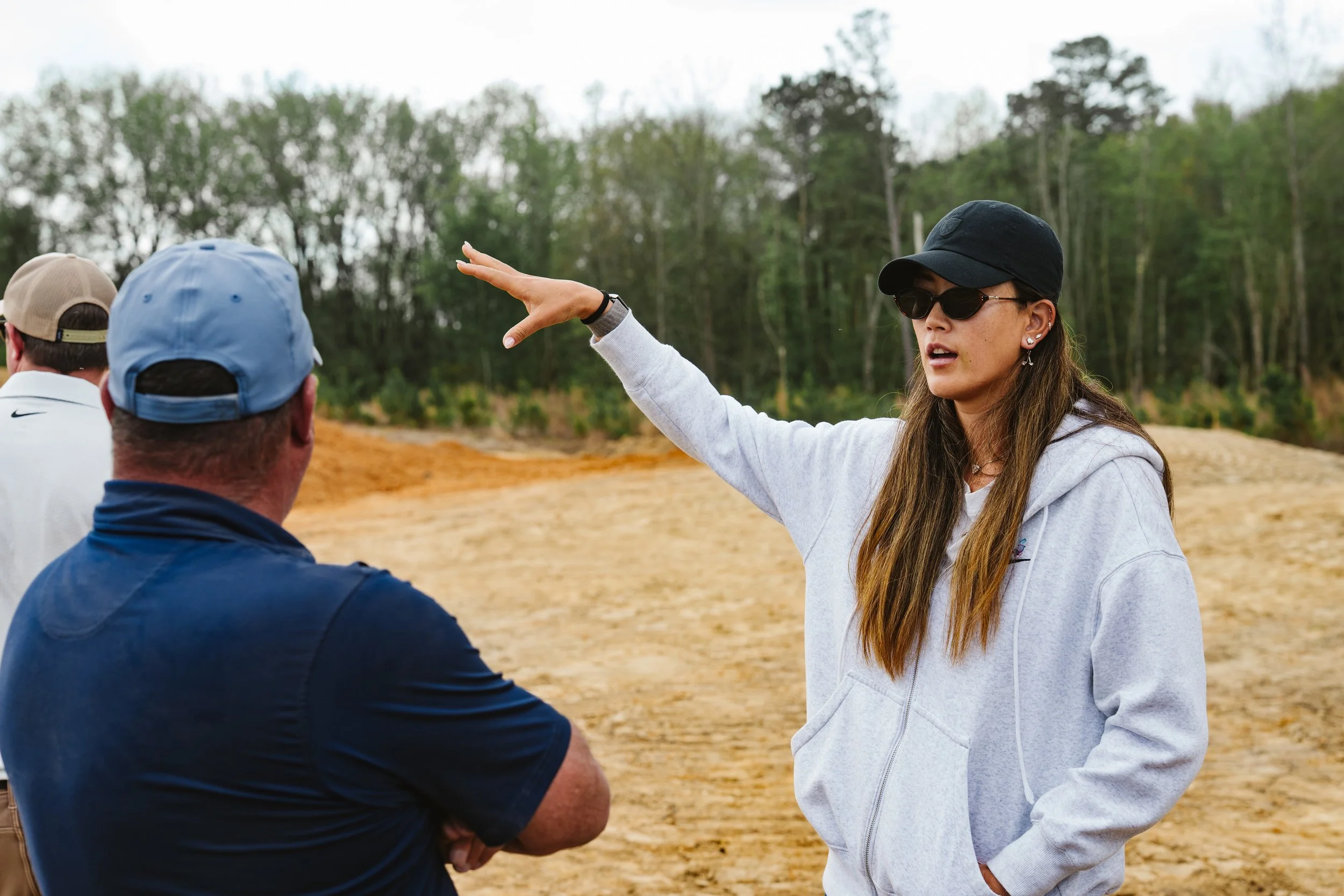
Michelle Wie West onsite at Candyroot. Photo courtesy of Candyroot Lodge. Photographer, Ryan Barnett.
Twenty years ago, I stood inside Augusta National, surrounded by a sea of men in khaki shorts and polos, while caddies worked the course itself in white canvas jumpsuits and green caps. Nobody had to tell me who the course was built for; it tells you itself, hole by hole, if you are paying attention. Earlier in my career, I ran the BMW Golf Cup International and hosted the US finals at Pinehurst, where the architecture taught me that a course is a record of what a golfer is allowed to attempt and what it forgives. That is why Michelle Wie West's first design, a new par-3 course in South Carolina, is not a small story to me. What changes when a different player shapes how the hole works?
From Accommodation to Design
For generations, women entering golf were expected to adjust to courses largely designed by men and around men's patterns of play. The forward tee became the industry's default answer to difference: shorten the distance, call it inclusion, and leave the underlying architecture largely unchanged. Women gained a different place to begin without gaining much influence over what came next. Alice Dye, who in 1983 became the first woman elected to the American Society of Golf Course Architects, challenged that thinking decades ago by advocating purpose-built forward tees, an intervention unusual enough to prove the larger point.
Michelle Wie West, the 2014 U.S. Women's Open champion, is designing her first golf course. Sweet Tooth, a par-3 layout at Candyroot Lodge in Jefferson, South Carolina, designed with architect Mike Koprowski, is no beginner's warm-up. Elastic tee boxes, long teeing areas that stretch or shrink a hole, and multi-pin greens, putting surfaces with several possible hole locations, let a hole play at different lengths depending on the day, and two scorecards split the difficulty: one traditional par-3 layout for better players, another that turns select holes into par-4s and par-5s for beginners and juniors. A beginner gets a real taste of a bigger course in a smaller, less intimidating setting, while a low-handicap player still faces a forced carry, a shot that must clear a hazard with no safe way around it, and a harder angle into the green.
Two different questions, asked of two different golfers, built into the same hole. When she announced the project, Wie West said she wants a place "where families can connect," where kids discover golf for the first time and players of every level feel welcome. A parent seeking a real test and a child discovering the game for the first time can play the same hole together, each facing the version built for them. Here, inclusion is built into how golf works.
Who Holds the Pen
Holding the pen means deciding, hole by hole, who the game welcomes and who it punishes. Golf course design remains one of the most narrowly represented professions in sport. A 2021 First Call Golf report found that only four women had ever been elected to the American Society of Golf Course Architects, and only two women remained active members of the roughly 170-member organization at the time. The scarcity reflects an industry built on apprenticeships, commissions, and established designers, pathways that have rarely opened to women.
Augusta National admitted its first female members in 2012. The club discloses little about who holds authority on its tournament and course-setup committees. Membership opened; decision-making authority remained harder to see.
The Lesson Beyond Golf
Who signs the check influences what a company builds. Who writes the curriculum determines what students are taught. Who designs the course decides which players must adapt and which are considered from the beginning. The mechanism is the same.
Every institution has a version of the forward tee: a process or policy built around whoever was in the room when it was written, then discounted for everyone who came later without ever being rebuilt. A mentorship program bolted onto a promotion process nobody rewrote is a forward tee. A seat at the table means little without the pen.
For most of golf's history, courses were rarely redesigned for the players they excluded, because those players rarely held decision-making authority. Sweet Tooth shows what happens when that changes for even one course. A skeptic could argue that crediting Wie West with holding the pen overstates her role, since Koprowski is the credentialed architect of record, and her name may be doing more work in the coverage than her hand in the design. That is a fair caution, and it is why the credit belongs to both of them. But a shared credit still changes who the next architect consults before drawing a hole, and that matters. It records more than her continued participation in golf: her collaboration with Koprowski marks a transformation, from playing within golf's inherited architecture to shaping what the next player encounters. She has held the club for her whole career; now she holds the pen. That is a competitive edge that is hard to copy.
Sources
Erik Matuszewski, "Michelle Wie West Designing New Par 3 Golf Course At Candyroot Lodge," Forbes, May 19, 2026. Reporting from Golfdom, Athlon Sports, and Golf.com on Sweet Tooth's design and Candyroot Lodge. Michelle Wie West, as quoted in the Candyroot Lodge project announcement, May 2026, reported by Golf Course Architecture. First Call Golf, "Why are there so few women golf course architects?" (2021), on ASGCA membership figures.
About The Edge
The Edge examines how culture, business, leadership, sport, and global systems shape markets, institutions, and leaders' decisions. It features original essays and analysis by Angeli Gianchandani.
Copy Editor
Enid Burns is a Detroit-based journalist and editor. Her work has appeared in CNN, the New York Post, and CNET. She serves as copy editor for The Edge, reviewing each article before publication.

About the Author
Angeli Gianchandani is a global brand strategist, cultural intelligence practitioner, and educator. She is the creator of the CULTURE Framework™, and advises leaders on commercial growth, brand value, and the decisions connecting current performance to long-term opportunity. She is Adjunct Faculty at NYU School of Professional Studies, Visiting Lecturer at African Leadership University, and holds a master's degree from Tufts University’s Fletcher School. Read more at mobilitygirl.com/theedge and Authory.