When the Math Changes
What Alex Eala’s US Open Run Reveals About How Women’s Tennis Recognizes Value.
Angeli Gianchandani examines how one player's audience moved faster than the traditional signals used to recognize her value.
The Edge | Angeli Gianchandani · September 10, 2026 · 4 min read
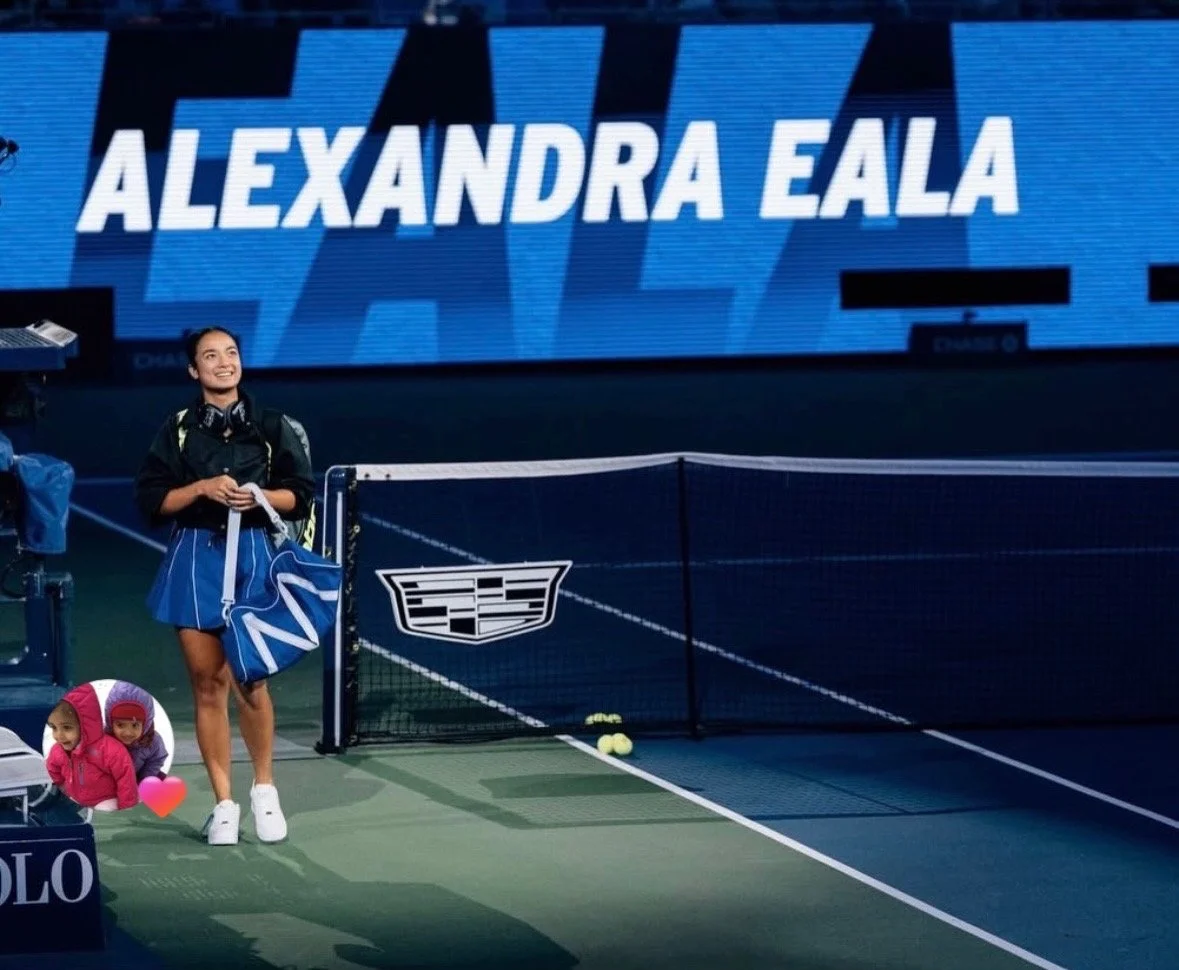
The scoreboard says Eala. So does this young fan's Instagram, hearts and likes and all. Photography by Owen Reynoldson
For decades, tennis has relied on a familiar set of signals to determine who receives its biggest stages. Ranking and seeding offer the clearest evidence. Past performance, name recognition, and television appeal fill in the rest. By the time a player reaches a show court, demand around them has usually been validated by something the tournament already knows how to measure.
Alex Eala disrupted that sequence. Her audience arrived before her ranking could fully explain it. In January, Lindsay Davenport could not get onto Court 6 at the Australian Open. Hundreds of other fans reached the same wall of people and turned back. Tournaments report the fans who entered. The demand outside the gate never appears in the official attendance count. Eala was then ranked outside the world's top 40, a 20-year-old from the Philippines placed on one of the tournament's smaller courts. The assignment made sense according to the established signals. The crowd did not.
A Sequence Running in Reverse
By the time Eala reached the US Open ranked No.18, the traditional signals had begun to catch up, but they still did not fully explain the scale of her following. Her crowds grew throughout the American hard-court swing in Washington, Toronto, and Cincinnati, beyond what her ranking alone could explain.
American player Emma Navarro said, before the draw was even made, that she expected the tournament to feel like a road game for whoever faced Eala, including Americans, at their own home major. Players rarely talk up an opponent's crowd. When one does, unprompted, it is worth treating as evidence that demand had already outrun the number meant to describe it.
The US Open is the United States Tennis Association’s own showcase, built around home stars in prime time. A small court risked repeating Melbourne. Arthur Ashe offered the capacity, but it also meant putting a home player across the net from someone capable of generating a crowd of her own. Wimbledon had complicated the picture: Mary Jo Fernandez noted it felt different there, not because the crowd was smaller, but because the more enclosed Center Court had muted the effect rather than amplified it. The venue changed how the demand was expressed, but not the fact that it had already arrived.
The USTA Had Already Answered
Patrick McEnroe spent six years as the USTA's general manager of player development and remains the longest-serving Davis Cup captain in American history. He knows what it costs to develop a Grand Slam contender over a decade, with no guarantee it produces someone recognizable beyond tennis. His public warning that organizers should not put Eala on a side court recognized an asset the USTA had not built and could not easily replace, one whose demand had outpaced the signals meant to validate it.
The tournament had already recognized her commercial appeal in its mixed doubles showcase. Eala received a wildcard alongside Félix Auger-Aliassime in a field built around the sport’s most commercially compelling pairings. They lost in the first round, but the result did not undo what the invitation had already shown. The harder question was whether the tournament would allow the same evidence to shape its singles schedule.
What Happened, and What It Does Not Prove
Eala won her first two rounds in straight sets at Louis Armstrong Stadium. For the third round, against her friend Iva Jovic, organizers moved her to Arthur Ashe. Jovic won, 7-5, 3-6, 7-5, in a three-hour match that justified the scale of the stage it had been given. It was Eala's best US Open result to date, played on a court assignment that reflected more than ranking alone.
On the court at Arthur Ashe, the demand finally had room. But nothing about how the tournament handled Eala proves the underlying pattern has changed for the next player whose drawing power exceeds what her ranking predicts. The tournament recognized Eala's demand in its court assignments. Whether audience demand becomes a consistent input into court assignments, rather than an exception recognized only after the evidence becomes impossible to ignore, remains unresolved.
The Value Still Waiting to Be Priced
This is Trapped Value™: worth that already exists but stays uncaptured because the system measuring it was built to recognize something else. Ranking records competitive results as they accumulate. It has no place for an audience that arrives ahead of the signals meant to validate it, or for the moment that audience turns a routine court assignment into an operational problem the established indicators never anticipated.
The mixed doubles wildcard and the move to Arthur Ashe are what handling that value actually looked like. Neither required a new rule or a new formula. Each was a single, deliberate decision to act on demand the tournament could already see, ahead of the moment ranking would have caught up on its own.
The traditional signals are not wrong, but they are no longer sufficient. A skeptic could argue that ranking works precisely because it ignores popularity, and that scheduling around crowd size invites its own distortions, favoring marketable players over deserving ones. That risk is real. But Eala's case does not ask to replace ranking. It asks whether a tournament that already tracks broadcast reach and ticket demand commercially should use that information when assigning courts, rather than waiting for the ranking to validate what the crowd already knows.
Institutions rarely miss value because it is invisible. They miss it because it arrives in the wrong order: a crowd before a number, confronting a system never built to read it that way.
About The Edge
The Edge examines how culture, business, leadership, sport, and global systems shape markets, institutions, and the decisions leaders make. It features original essays and analysis by Angeli Gianchandani.
Copy Editor
Enid Burns is a Detroit-based journalist and editor. Her work has appeared in CNN, the New York Post, and CNET. She serves as copy editor for The Edge, reviewing each article before publication.

About the Author
Angeli Gianchandani is a global brand strategist, cultural intelligence practitioner, and educator. She advises leaders on commercial growth, brand value, and the decisions connecting current performance to long-term opportunity. She is the creator of the CULTURE Framework™ and Trapped Value™, applied throughout her writing and advisory work to identify unrealized value inside institutions and organizations. She is Adjunct Faculty at NYU School of Professional Studies, Visiting Lecturer at African Leadership University, and holds a master's degree from The Fletcher School at Tufts University. Read more at mobilitygirl.com/theedge and Authory.